
Most people go to a technology event for the talks and come back remembering the conversations. A good talk gives you an idea. A good conversation gives you a collaborator, a mentor, a job lead or a friend who works on the same problems you do. The difference between the two is rarely luck. It is preparation, a little courage in the room, and a follow up that actually happens.
This guide covers networking at technology events in India: what to do before you arrive, how to talk to people during the event, and how to stay in touch after it ends.
Before the event: do the homework
Networking starts before you leave home. An hour of preparation makes the whole day easier, because you arrive knowing who you want to meet and what you want to ask them.
Read the speaker list and the agenda
Look at the talks, not just the titles. Pick two or three sessions where the speaker does work close to yours, and read a little about what they have built or written. A specific question beats a general compliment every time.
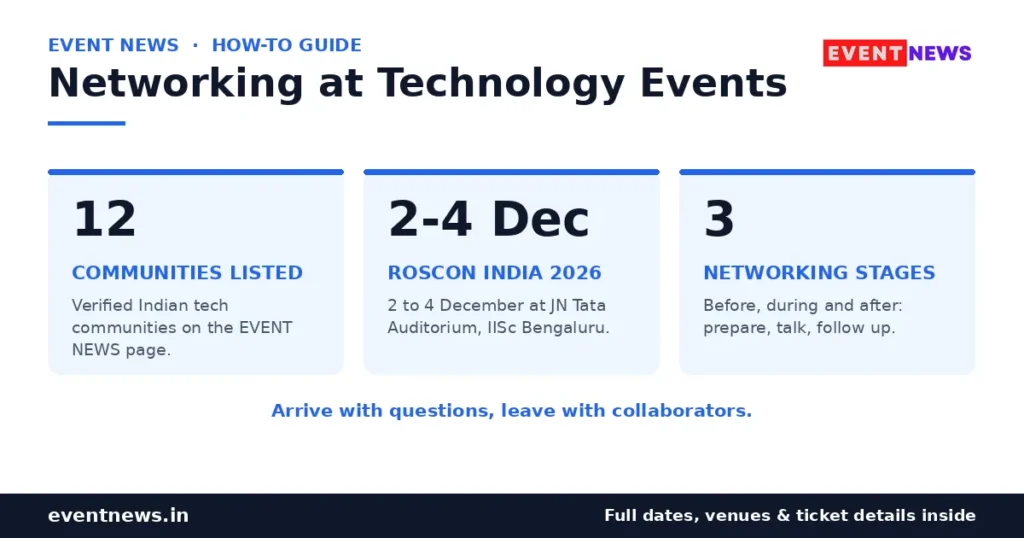
At a conference like ROSCon India 2026, which runs 2 to 4 December 2026 at the JN Tata Auditorium, IISc Bengaluru, Day 1 is workshops and Days 2 and 3 carry community talks, keynotes and a startup showcase. Knowing which day matches your interests tells you who will be in the room with you.
Find out who is attending
Most events have a community behind them. The communities page on EVENT NEWS lists 12 verified Indian tech communities, from Google Developer Groups and AWS user groups to open source, WordPress and security communities. If the event is run by one of them, join that community first. GDG chapters, FOSS United chapters and AWS user groups all run regular meetups, and their members are usually happy to welcome a first timer and introduce them around.
For example, Chennai AI Sangamam 2026 on Saturday 5 December 2026 brings six Chennai communities together for one day at the Comcast Office in Thoraipakkam: AI Geeks Chennai hosts, with Tamilnadu JUG, Sapiens Campus, SheBuilds, Digital Dreamers Den (D3) and Chennai React. That is six rooms of people in one venue, and knowing that in advance tells you the day is built for meeting people outside your usual circle.
Set one small goal
Do not aim to “network with everyone”. Pick one goal you can actually meet: talk to three people who work on your stack, find one person hiring in your area, or ask one speaker a question after their session. A small goal keeps you moving instead of standing near the coffee table wondering what to do next.
Prepare a short introduction for yourself: your name, what you build or study, and one thing you are working on or curious about. Thirty seconds is enough, and it gives the other person three things to respond to. A job title alone gives them none.
During the event: talks, the hallway and the booths
Use the talks as conversation starters
The easiest opening line at any event is about the session you both just watched. Sit near people who ask good questions during a talk, because they are usually the people worth talking to afterwards. After a session, the speaker is often standing near the stage for a few minutes. That is your window.
Do not skip the hallway track
The hallway track is the informal name for the conversations between sessions, and at many events it is where the real value sits. The conference listing on EVENT NEWS says it plainly: come for the talks, but plan time for the hallway. Coffee queues, lunch tables and the walk between halls are all fair game. Join a group that has an open space, listen for a minute before speaking, and join the topic rather than changing it.
Lunch is the best networking slot of the day. Do not eat alone with your phone. Sit at a table with strangers, introduce yourself, and ask what brought them here. At a small event the room is forgiving: Maker Thursday: Prototype Mastery in Kochi on Thursday 17 December 2026 is a free two hour evening at TinkerSpace, 7:00 to 9:00 PM, with a live hardware demo and open question time.
After the event: follow up within two days
This is the step almost everyone skips, which is why it matters most. A conversation at an event is worth very little if neither person ever speaks to the other again. Follow up within 48 hours, while both of you still remember the conversation.
Send a short message: who you are, where you met, the one thing you talked about, and one concrete next step. “Good to meet you after the ROSCon startup showcase. Here is the repo I mentioned” is a follow up. “Nice meeting you, let us stay in touch” is not, because it asks the other person to do the work of remembering why you met. Then do the thing you promised, share the link, send the introduction, or answer the question, within the week. One kept promise builds more trust than ten exchanged business cards.
Join the community, not just the event
One event is a day. A community is a calendar. The groups on the communities page meet regularly: Bengaluru WordPress meets monthly on the third Saturday, FOSS United Lucknow meets regularly at venues like IIIT Lucknow and the InMobi office, GDG chapters run meetups through the year, and null, the open security community, runs monthly meetups and hands-on sessions on information security across its city chapters. Showing up a second and third time is what turns a contact into a connection, because people remember the face they have seen before.
Online networking: the conversation does not need a venue
Not every useful connection happens in person. Community groups on chat platforms, forum threads and event discussion channels are where a lot of Indian tech networking now happens, and they reward the same behaviour as the hallway: show up regularly, answer questions, and share what you are learning.
The pattern is simple. Join the community group for your city or your stack, which you can find through the communities page, and read for a week before posting. Then contribute something small: an answer to a question you know, a link to a talk you found useful, or a note about a problem you solved. People notice regular contributors, and when an in person meetup comes around, you will already know names and faces.
What not to do
Networking has a bad reputation because a small number of people do it badly. Avoid these five mistakes and you will already be ahead of most of the room.
- Do not pitch without context. Opening a conversation with your product, your startup or your job opening tells the other person you see them as a lead, not a person. Learn what they do first. If there is a fit, it will come up naturally.
- Do not collect cards without following up. A stack of business cards is not a network. Ten conversations and two follow ups beat fifty introductions and none.
- Do not only talk to speakers and sponsors. The person sitting next to you, a student or a junior developer, may be your co-founder in two years. Talk to the whole room.
- Do not interrupt a deep conversation to introduce yourself. Wait for a natural pause, or come back later. A badly timed interruption is remembered, and not fondly.
- Do not disappear after one event. Networking is a habit, not a task. The people who get the most from it are the ones who keep showing up, in the same communities, month after month.
Frequently asked questions
How do I network at a tech event if I am introverted?
Prepare more and perform less. Arrive with your questions written down, pick small events first, and give yourself permission to talk to three people and then take a break. A meetup like Maker Thursday in Kochi, a two hour evening in one room, is a gentler start than a three day conference.
Should I bring business cards?
They help, but they are not required. A phone with a QR code for your LinkedIn profile or portfolio does the same job. What matters is that the other person leaves with a way to reach you and a reason to do it.
How do I find tech events to network at?
Start with the meetup listing and the communities page for your city, then check the city guides for the community and meetup sections. The guide to tech events in Bangalore is a good model: it has a dedicated developer meetups section covering GDG Cloud Bengaluru, AWS User Group Bengaluru and WordCamp Contributor Day, so you can see which groups are active before you pick an event.
Last verified: 28 November 2026.