
Most students look for tech workshops the wrong way round. They search the whole internet first, find paid courses dressed up as workshops, and wonder why nothing fits their timetable or budget. Start closer to home: your own campus, and the student communities that already meet there.
Start with campus communities
If your college has a Google Developer Groups on Campus chapter, join it. These university groups, run by student organisers, were called Google Developer Student Clubs until Google renamed them in 2024. Membership is open regardless of branch or year, and chapters run hands-on workshops, study jams, hackathons and speaker sessions. Find your chapter on the GDG community site. If your college has none, join the city GDG instead.
FOSS United works the same way. It runs city chapters that meet monthly in cities including Bengaluru, Mumbai, Chennai, Hyderabad, Delhi, Pune, Goa, Lucknow and Mangalore, plus campus FOSS Clubs across India. The clubs are student-led and focused on free and open source software, so workshops are practical: Git, Linux, web development, and contributing to real projects.
AWS user groups are the third community worth joining early. Our communities page lists AWS User Group Bengaluru and AWS User Group Pune, both running free meetups on AWS services, architecture and AI on AWS. Pune also runs the annual AWS Community Day.
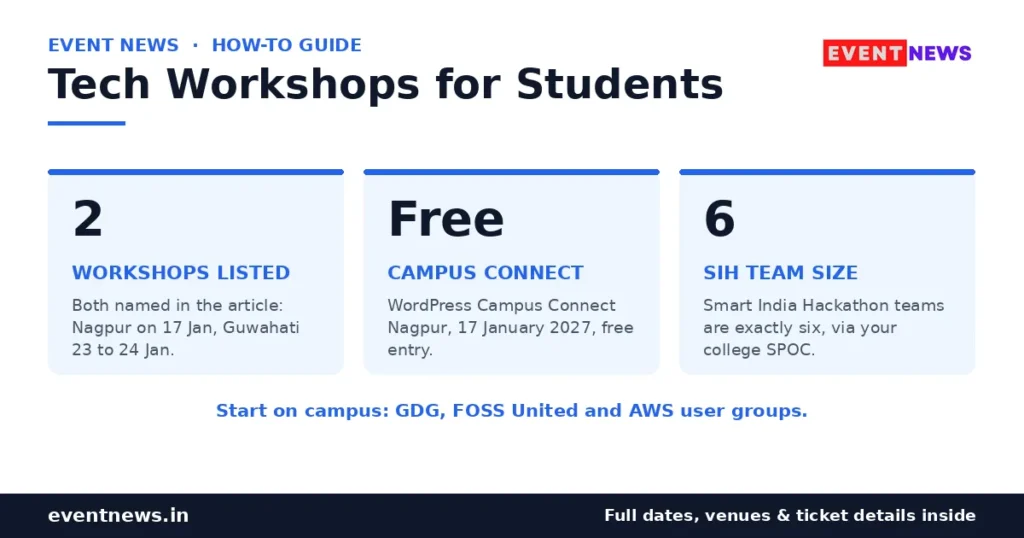
One more campus route matters. For government hackathons, the route runs through your college, not an open registration page. Our guide to the Smart India Hackathon explains it: your college appoints a faculty SPOC, or Single Point of Contact, who runs the internal hackathon, and only winning teams are nominated nationally. Students cannot register alone. Find the faculty coordinator early: SPOC registration for the 2026 cycle closed on 31 July 2026, weeks before launch.
Free versus paid: what to check before you register
Workshops in India split into two different things that share a name. A free community workshop is usually run by a club, lasts a few hours, and teaches one skill with exercises you do yourself. A paid workshop is often a commercial training session, sometimes very good and sometimes a long sales talk with a certificate at the end. Both can be worth your time; the mistake is treating them as the same thing.
Before you register, check five things: who is running it, what you will actually do, the timings and venue, what the fee covers, and the registration deadline. If a listing cannot answer those questions, treat that as information in itself.
The two workshops on our workshop archive on 28 November 2026 show the range, and they are the only two on that archive: the list is thin, and we are building it rather than pretending it is complete. The first is WordPress Campus Connect at Ratan Tata Maharashtra State Skills University in Nagpur, on Sunday 17 January 2027 from 10:00 AM to 2:00 PM, registration from 9:00 AM. It is free, for around 80 students, and covers setting up WordPress, choosing themes and plugins, and building a first website, then a practical session, a project showcase and questions. Bring a laptop; no experience is needed. The venue is on the second floor of the Skills University Metro station in Somalwada, Nagpur. No registration deadline has been announced. Full details are on the WordPress Campus Connect Nagpur event page.
The second is the World Technocon Workshop Series at IIIT Guwahati, on Saturday 23 and Sunday 24 January 2027, and it is the opposite model. Twenty parallel one-day workshops run across the two days, ten each day, each from 10:30 AM to 5:30 PM. You register per workshop at Rs 1,944 plus GST each, 35 percent off the listed Rs 2,990, and a Certificate of Completion is included as an e-certificate and a printed copy. Topics range from data science and ethical hacking to AI for business owners and UX design with AI. State one point plainly: this is a commercial series hosted on the IIIT Guwahati campus, run by World Technocon, not by IIIT Guwahati. No registration deadline has been announced. Full details are on the World Technocon Guwahati event page.
That contrast is the lesson. Nagpur is free, small and campus-based, built around one thing you finish on the day. Guwahati is paid, large and commercial: pick one topic, pay per workshop, leave with a certificate. Neither is better in general. Ask which matches what you need this month. On price, watch the small print: a fee without GST is not the final price. On free workshops, seats are limited, so register early even when the ticket costs nothing.
Online workshops and webinars
If no workshop is running in your city this month, an online session is a sensible start, not a second-best option. A webinar costs nothing, needs no travel, and lets you judge a topic in an hour before committing a weekend to it. The risk is treating it like a video: watch it, close the tab, keep nothing. Treat it like a workshop instead: keep a notebook open, try the steps as the speaker does them, and write down the one thing you will build afterwards.
Our webinar archive is, like the workshop archive, thin: on 28 November 2026 it lists one event, NVIDIA Nemotron Labs on open-model Indic-language AI with NVIDIA Nemotron 3.5 Super VL, online on Friday 4 December 2026, and free. When you find an online workshop elsewhere, check the same details, and whether a recording is provided. Online sessions are also a way to test a community before joining in person.
What to carry and what to build
A workshop is different from a talk. For a talk, you need a notebook and a charged phone. For a workshop, you need a working machine and the software already installed. Bring a laptop, charged, with the charger, and install whatever the organiser names in advance. The Nagpur workshop asks students to bring a laptop; the Guwahati workshops run seven hours, and a dead battery halfway through is a wasted ticket. If no software is named, bring a browser, a code editor, and a way to take notes, and arrive early to sort out Wi-Fi and logins.
Bring a valid student ID: student workshops, student pricing and campus entry can all depend on it. Bring a notebook and pen as well as the laptop, because when the Wi-Fi drops the notebook keeps the session useful.
Set a target smaller than “learn WordPress” or “learn AI”: one finished thing, a live website, a working script, a deployed page, a GitHub repository with a first commit. At Nagpur, the target is built into the schedule: students build and launch a real site and show it in the project showcase. At Guwahati, the target is the workshop you picked: one topic, one day, one certificate. Pick your target before you arrive, and judge the day by whether you finished it. Ask questions while the work is happening: the instructor can fix a mistake in a minute, and half the room is usually stuck on the same step.
After the workshop: portfolio, certificates, next event
Save what you built while you still remember how it works. Push the code to GitHub, publish the site if you built one, and write a short note about what you did: the topic, the tool, the problem you hit, and how you fixed it. That note is worth more than the certificate, because it is what you can show a recruiter, and what you will remember in six months.
Certificates have a place, but keep them in proportion. The Guwahati workshops include a Certificate of Completion, and a certificate from a workshop you attended and finished is a fair record of the day. It is not a qualification, and it does not replace the project. Put the certificate on your profile if you want to, but put the project first, with a link that works.
Then follow up with the people, not just the material. If the workshop was run by a campus club or city chapter, join the group properly: the group chat, the next meetup, the mailing list. Thank the organiser, share the project you built, and ask what the group is running next. That is how a one-day workshop turns into a community, and the community is where the next invitation comes from. Pick the next event while this one is fresh: check the workshop archive again, and the city guides for your city, including the Mumbai guide and the Delhi guide. If nothing is listed for your city yet, check the clubs again, because a workshop announced in a club group this week may only reach the listings next week.
Last verified: 28 November 2026.