Introduction
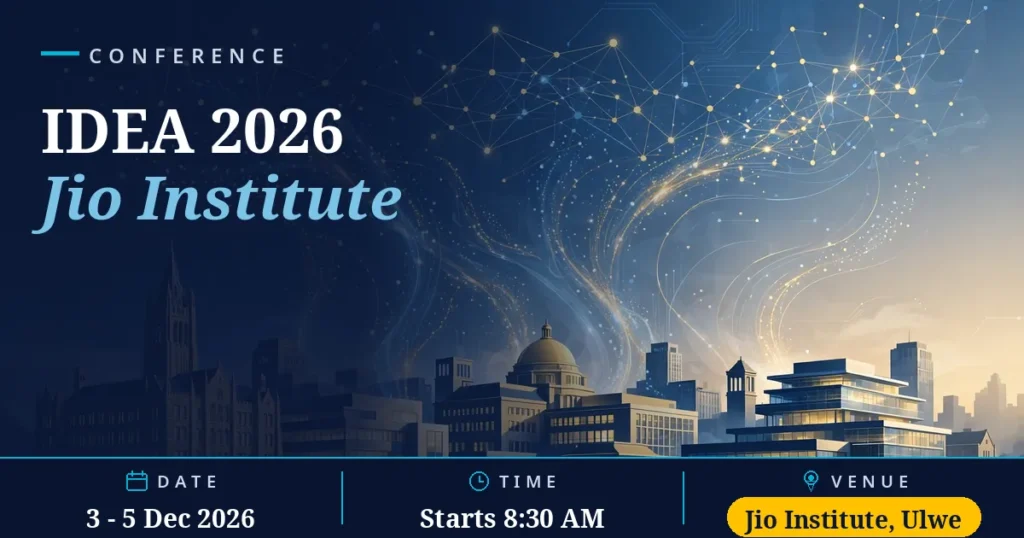
IDEA 2026, the International Conference on Intelligent Data Engineering and Artificial Intelligence, is Jio Institute’s inaugural international AI research conference. It runs 3 to 5 December 2026 at the Jio Institute campus in Ulwe, Sector 5, Navi Mumbai. Keynotes come from Carnegie Mellon, Google DeepMind, Microsoft, IBM Quantum and Monash; the programme combines paper sessions, workshops, tutorials, panels and demonstrations. Registration is open: student participation is Rs 4,500 and listener passes are Rs 6,000.
It is an academic conference with an industry thread: the audience is researchers, academicians, students, industry professionals and policymakers, and accepted papers will be published in Springer’s Lecture Notes in Networks and Systems (LNNS) series.
Event Overview
IDEA 2026 is the first edition of what Jio Institute plans as a long-term conference series, spanning intelligent data engineering and AI from theoretical advances to large-scale deployments, and from foundation models to the governance and ethics of AI systems.
The conference is organised into six tracks: Intelligent Data Engineering and Big Data; Machine Learning and Deep Learning; Computer Vision and NLP; Ethical, Fair and Responsible AI; AI Applications and Case Studies; and Emerging Trends and Future Directions. Topics range from distributed and federated data architectures and scalable machine learning to LLMs, multimodal and generative AI, trustworthy AI, reinforcement learning and quantum and hybrid AI models.
What to Expect
Three days of keynotes, paper sessions, workshops, tutorials, panels and demonstrations. Day 1 opens with registration and breakfast from 8:30 to 9:45 AM, followed by the inauguration from 9:45 to 10:45 AM. A Doctoral Consortium, a Young Scientist Forum and a Student Research Paper Competition run alongside the main programme.
Registration includes all paper sessions, keynotes, panels and invited talks, entry to workshops and tutorials, a certificate, and breakfast, lunch and dinner with networking sessions.
Papers went through double-blind peer review, three reviewers each, with an expected acceptance rate of around 25 to 30 percent; submissions closed 30 June and acceptances were notified 20 August.
Who Should Attend
IDEA 2026 is aimed at researchers and academicians, students and early-career researchers seeking exposure and mentorship, industry professionals and data scientists deploying AI applications, and policymakers interested in AI governance.
Students can attend as participants at Rs 4,500 (attendance only), an accessible way to hear international researchers and present through the student competition and doctoral consortium.
Key Highlights
- Inaugural international conference on Intelligent Data Engineering and AI at Jio Institute
- Three days, 3 to 5 December 2026, at Jio Institute, Ulwe, Sector 5, Navi Mumbai
- Keynotes from Carnegie Mellon, Google DeepMind India, Microsoft Hyderabad, IBM Quantum, Monash, Iowa State and Missouri S and T
- Six tracks: data engineering, machine learning, computer vision and NLP, responsible AI, applications, emerging trends
- Proceedings published in Springer’s Lecture Notes in Networks and Systems (LNNS) series
- Doctoral Consortium, Young Scientist Forum and Student Research Paper Competition
- Student participant Rs 4,500; Listener Rs 6,000; Indian author Rs 9,000 per paper; international author USD 200
Programme and Speakers
Day 1 opens with registration and breakfast from 8:30 to 9:45 AM, followed by the inauguration from 9:45 to 10:45 AM. The full schedule is published on the official conference page and in the schedule PDF.
Keynote speakers include Dr. Carlos Busso (Carnegie Mellon University), Dr. Vaibhav Rajan (Google DeepMind India), Dr. Qi Li (Iowa State University), Dr. Abhinav Dhall (Monash University), Dr. Manish Gupta (Microsoft Hyderabad), Dr. Ritajit Majumdar (IBM Quantum) and Dr. Sanjay Madria (Missouri S and T).
Registration Information
Registration is open on the official conference page. Fees are Rs 4,500 for student participants (attendance only), Rs 6,000 for listeners, Rs 9,000 per accepted paper for Indian authors, and USD 200 per accepted paper for international authors. Early bird registration closed on 2 September 2026, and no closing date for listener and student registration is stated.
Paper submission closed on 30 June 2026, so new papers cannot be submitted; student and listener registration remains open.
Venue and Location
The conference takes place at Jio Institute, Ulwe, Sector 5, Navi Mumbai, Maharashtra. Jio Institute is a multidisciplinary higher education institution established by the Reliance Foundation, and the campus has computing laboratories, classrooms, multipurpose halls and collaborative spaces suited to an international technical conference. Ulwe is in Navi Mumbai, part of the Mumbai Metropolitan Region, reachable by road and rail from Mumbai and Pune.
Why This Event Matters
India produces a large share of the world’s AI research talent, but most top AI conferences still happen abroad. A new international conference hosted in India, with keynotes from Carnegie Mellon, Google DeepMind, Microsoft and IBM Quantum, gives Indian researchers and students a serious venue without the cost and visa hassle of travelling overseas.
The Springer LNNS proceedings matter too: a published paper in an indexed series is a concrete outcome, and the selective review process gives the programme credibility from its first edition.
Event Details
- Event: IDEA 2026 – Intelligent Data Engineering and Artificial Intelligence (Jio Institute)
- Date: 3 to 5 December 2026
- Timings: Day 1 registration from 8:30 AM; end time Not Announced
- Venue: Jio Institute, Ulwe, Sector 5, Navi Mumbai, Maharashtra
- City: Navi Mumbai, Maharashtra (no city term on the site)
- Format: In-person
- Organiser: Jio Institute (Reliance Foundation)
- Tickets: Student participant Rs 4,500; Listener Rs 6,000; Indian author Rs 9,000 per paper; international author USD 200
- Registration deadline: Not Announced (early bird closed 2 September 2026; paper submission closed 30 June 2026)
Last verified: 24 November 2026.